


If you're speccing out warehouse shelving for the first time, the terminology can slow you right down. Bay, upright, UDL, starter unit, extender unit. None of it means much until someone explains it in plain English. That's what this glossary does. We've pulled together the terms you'll actually hit when browsing our warehouse shelving range. Read it and you can check a spec sheet with confidence. You'll order the right unit first time, instead of guessing.
We've built this glossary differently to most. We haven't just listed definitions alphabetically with no context. Instead, we've grouped terms by the part of the buying decision they affect: how a unit is built, how it's rated for weight and how you configure and expand it. That way you're not hunting through unrelated entries to find the one term you need.
Structure: the parts that make up a warehouse shelving unit
Understanding warehouse shelving starts with knowing what you're looking at. Every unit, from a small stockroom shelf to a full longspan run, is built from the same core parts.
Bay
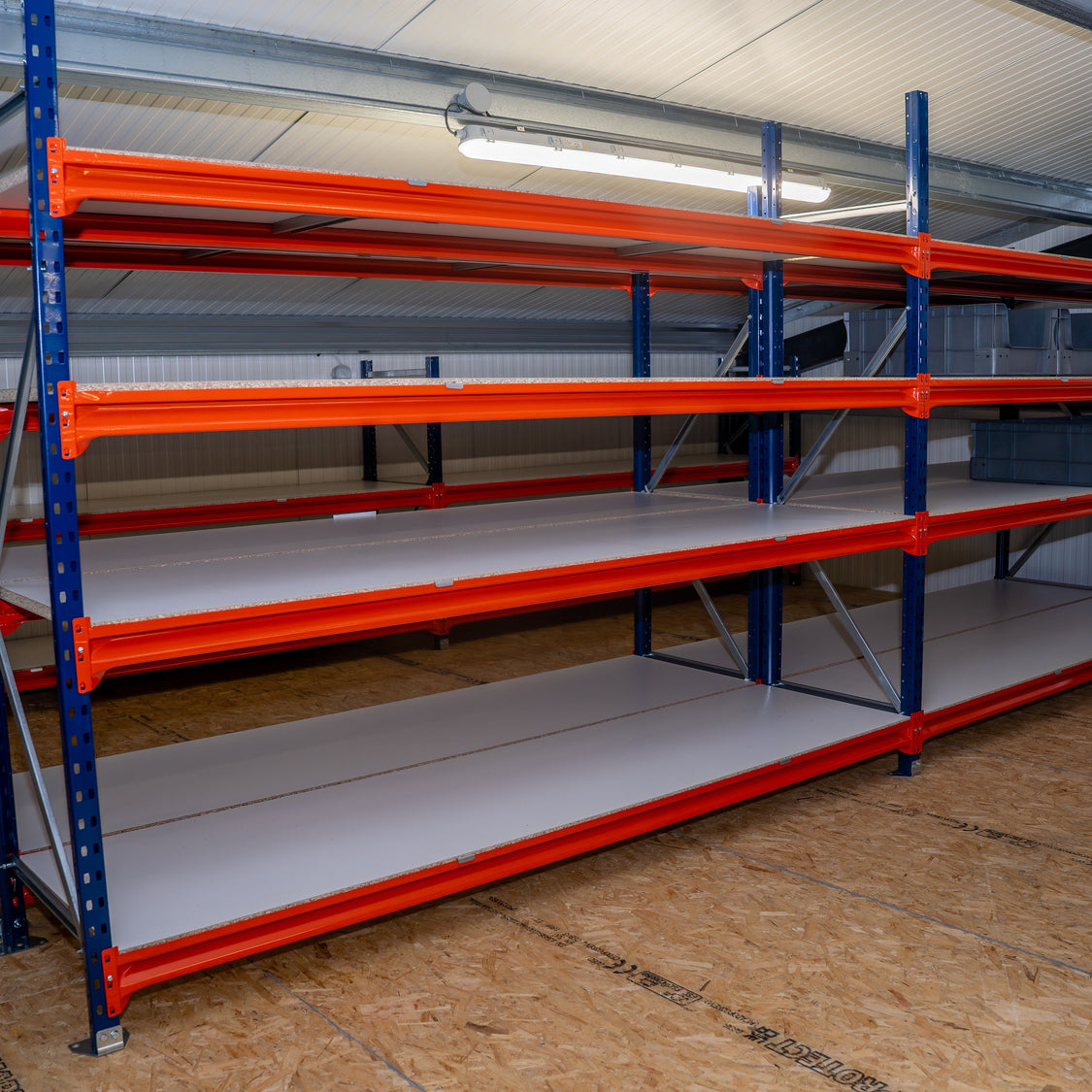
A bay is one complete shelving unit. It's two uprights plus the shelves (decking) that sit between them. When you're planning a run of shelving, you're really planning a row of bays side by side. A single bay works fine for a stockroom corner. Most warehouses order several bays in a row to make the most of a wall or aisle.
Upright
The upright is the vertical frame at each end of a bay. It carries the weight down to the floor. Its strength sets how much you can safely load onto every shelf above it. Uprights come in different heights and depths to suit your space. They're usually punched with slots, so you can adjust shelf height as your stock changes.
Decking
Decking is the shelf itself: the surface you actually load. On our longspan shelving and warehouse shelving, decking is commonly timber (chipboard) or steel panels. Which one suits you depends on what you're storing and how much airflow you need. Timber decking works well for general stock. Wire mesh decking is different. You'll also find it in our pallet racking accessories. It lets you see through to the level below and it helps keep dust from settling.
Span width
Span width is the horizontal distance between the two uprights of a bay. In other words, it's how wide each shelf is. A wider span means fewer uprights for a given run of shelving. That can suit long, lighter items. A narrower span gives you a stiffer, more rigid shelf for the same decking. You'll see span width listed as a filter option across our shelving and longspan ranges, so you can match it to your stock before you order.
Starter unit and extender unit
A starter unit is a complete, standalone bay with uprights on both sides. An extender unit shares an upright with the bay next to it, so it needs one less upright than a starter. Planning a run of three or more bays? Order one starter followed by extenders. It's the more efficient way to build a run out, and it's how our longspan and boltless ranges are designed to be configured.
Order one starter followed by extenders. It's the more efficient way to build a run out.
”Weight and safety: how shelving is rated
Weight and safety: how shelving is rated
Once you know the parts, the next question is always the same: how much can it hold? This is where warehouse shelving terminology gets more technical. It's worth getting right, though, because the numbers on a spec sheet are there to keep your stock and your team safe.
UDL (Uniformly Distributed Load)
UDL is the maximum weight a single shelf can safely carry, provided that weight is spread evenly across the whole surface. It's the figure you'll see quoted in kilograms on every shelf spec. It's also the single most useful number when you're comparing units. The word 'uniformly' matters here. A shelf rated for a certain UDL isn't rated to take that same weight stacked in one corner or on one small footprint. Always check the exact UDL for the specific unit you're ordering on its product page before you buy.
Bay load
Bay load is the total weight the whole bay can carry across all its shelves combined. It's a separate figure to UDL. It isn't simply UDL multiplied by the number of shelves. The uprights, base plates and any floor fixings all have their own limits. So a shelf-by-shelf UDL doesn't tell you what the full bay can take. For the full working on this, we've covered it in our guide to shelving load ratings.
Levels
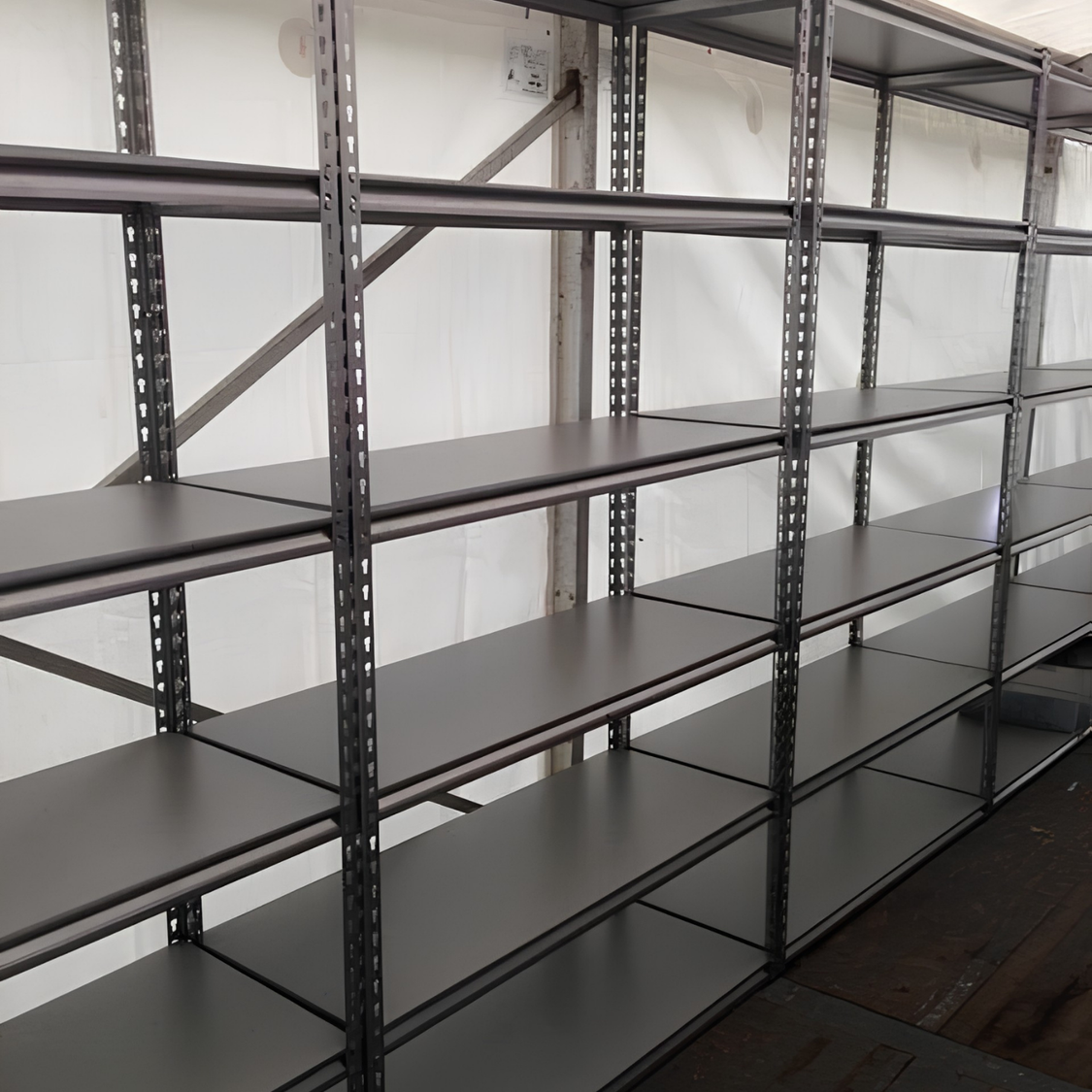
Levels means the number of individual shelves (decks) within a single bay, not counting the base. A four-level unit gives you four separate storage surfaces stacked vertically within the same footprint. That's one of the main reasons warehouse shelving makes such efficient use of floor space.
Adjustable shelving
Adjustable shelving lets you move shelf height up or down within the same bay. This is usually because the uprights are pre-punched at regular intervals. As stock changes over time, resetting shelf spacing without buying new uprights saves both money and downtime.
The word 'uniformly' matters here. A shelf rated for a certain UDL isn't rated to take that same weight stacked in one corner or on one small footprint.
”Configuration and assembly: how systems go together
Configuration and assembly: how systems go together
The last set of terms covers how warehouse shelving is actually assembled and expanded on site. This matters as much for a single stockroom bay as it does for a full warehouse fit-out.
Boltless
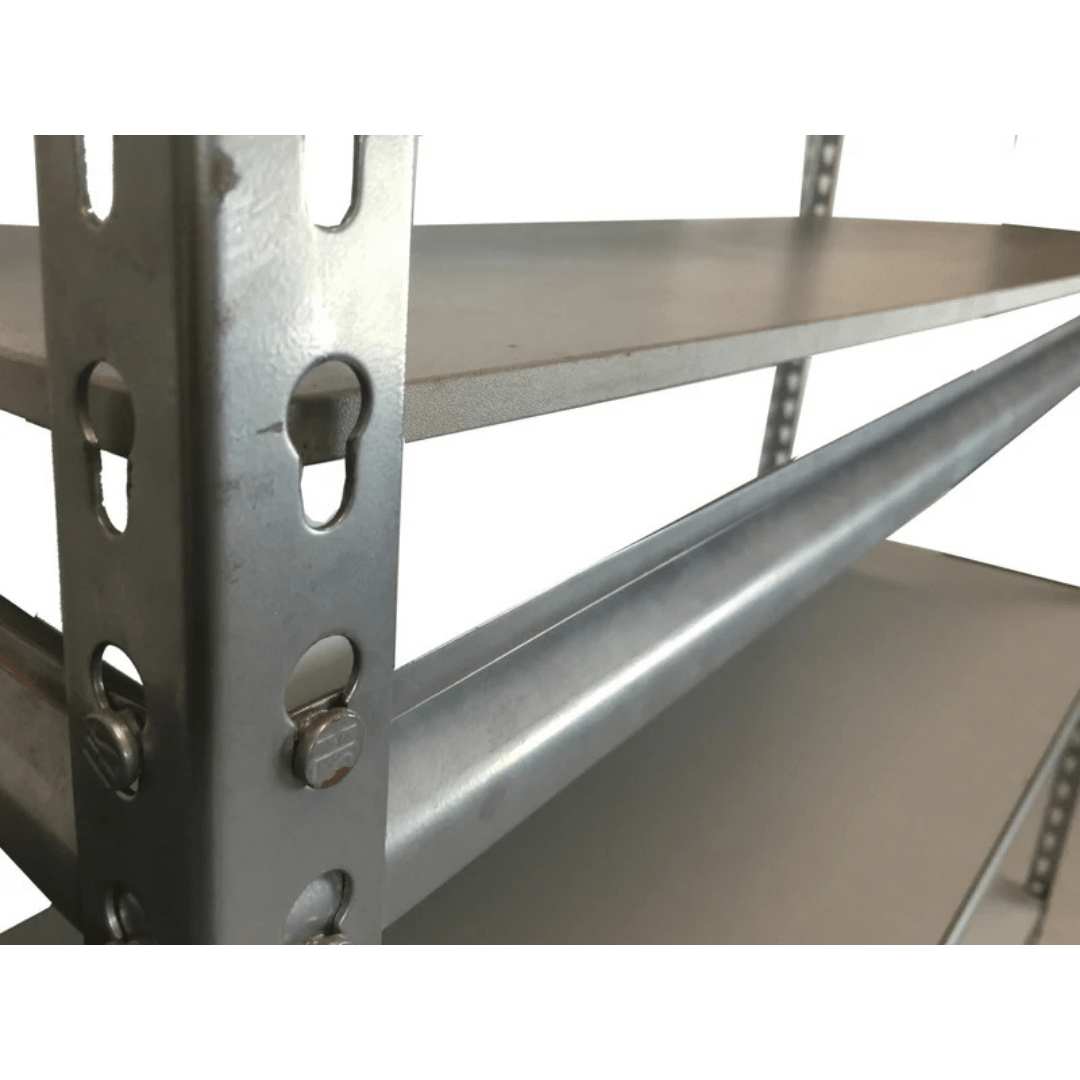
Boltless shelving connects using a rivet or clip design, rather than nuts, bolts or screws. It's built to go together with a rubber mallet in minutes, not a toolkit. That makes it a practical choice if you need to set up storage fast or reconfigure it later without any tools.
Frame material and coating
The frame is the steel structure of the uprights and supports. The coating is the finish applied to it, typically painted or galvanised. Choose galvanised steel shelving if your unit will sit in a cold, damp or outdoor-adjacent space. It's built to resist rust in those conditions. A painted frame is a solid, cost-effective option for a standard dry warehouse or stockroom.
Longspan shelving
Longspan shelving is a specific format built for hand-loaded items. These are items too bulky or awkward for standard shelving. But they don't need full pallet racking either. It uses the same bay, upright and decking structure described above. It's just scaled up in span width and shelf strength. That's why it sits as a common middle ground between office shelving and pallet racking in Irish warehouses. Always check the UDL for the exact depth and level count you're ordering, since this can vary across the range.
Knowing this terminology means you can read any product spec on our site and understand exactly what you're ordering. That's the number of levels, the frame coating and the UDL of every shelf, all in one glance. It also means you can talk to our team with the right questions ready, whether you're speccing a single bay for a stockroom or planning a full warehouse layout.
Browse our full warehouse shelving range to find the bays, spans and load ratings that suit your space. Or call us on 090 9673261 and we'll talk you through it.
Frequently Asked Questions
What is a bay?
A bay is one complete shelving unit — two uprights plus the shelves (decking) that sit between them. A single bay works fine for a stockroom corner, but most warehouses order several bays in a row to make the most of a wall or aisle.
What is UDL (Uniformly Distributed Load)?
UDL is the maximum weight a single shelf can safely carry, provided that weight is spread evenly across the whole surface. It's the figure quoted in kilograms on every shelf spec, and the most useful number for comparing units. It isn't rated to take that same weight stacked in one corner or on one small footprint.
What is bay load?
Bay load is the total weight the whole bay can carry across all its shelves combined. It's a separate figure to UDL — it isn't simply UDL multiplied by the number of shelves, since the uprights, base plates and any floor fixings all have their own limits.
What is boltless shelving?
Boltless shelving connects using a rivet or clip design, rather than nuts, bolts or screws. It's built to go together with a rubber mallet in minutes, making it a practical choice if you need to set up storage fast or reconfigure it later without any tools.
What is longspan shelving?
Longspan shelving is a specific format built for hand-loaded items that are too bulky or awkward for standard shelving but don't need full pallet racking. It uses the same bay, upright and decking structure as standard shelving, just scaled up in span width and shelf strength.
