


Storage in Ireland has changed shape. Finding more room is the hard part now. Getting more out of the room you've already got? That's where the wins sit.
Empty industrial space here ran at just 2.8 per cent in the second quarter of 2026. New units are getting smaller too. So this index does something plain. It lists the storage problems that turn up again and again. Irish stores, sheds, workshops and warehouses all qualify. Then it hands you the storage fixes for each one. Walk your own floor with it and you'll spot yours inside ten minutes. Every fix points at a product type in our shelving range. Every problem comes from a public source, so you can check our workings.
How we built the Irish Storage Index
So where do these eight problems come from? Two public sources, both free to look up.
Source one: the HSA hazard list for stores and warehouses
The Health and Safety Authority (HSA) publishes a hazard list for stores and warehouse areas. It's blunt reading. Blocked aisles. Unsafe stacking. Load ratings nobody has written down. Goods dropping off a shelf because there's no room left for them. Each line names a real cause of injury.
Source two: the 2026 industrial property data
Savills Ireland tracks industrial space here, and The Irish Times ran its second quarter figures in July. That data shows why storage in Ireland keeps getting harder to plan around.
Why we skipped the survey
We could have asked 500 warehouse managers to rank their worries. Plenty of reports go that way. But no Irish dataset ranks storage problems by how often they happen. Any ranking would be guesswork dressed up as data. We'd rather show our sources.
Instead, each entry pairs a logged cause with a sign you can spot on your own floor. Then the fix that clears it. That's it.
What the 2026 figures say about storage in Ireland
Take-up looks healthy on paper. Look at the shape of it and the story shifts.
Dublin take-up bounced back in the second quarter
| What Savills measured (Q2 2026) | Figure |
|---|---|
| Dublin take-up | 619,000 sq ft across 14 deals |
| Change year on year | Up 13 per cent |
| Average deal size | About 44,200 sq ft |
| Space taken in units built since 2020 | 60 per cent (up from 50 per cent in Q1) |
| Irish vacancy rate | 2.8 per cent |
| Average size of a newly finished unit | 24,900 sq ft (2025: 96,000 sq ft) |
| Space already reserved | More than 1 million sq ft |
The first few rows read like a market in good health. The bottom rows are the ones that should make you think.
”Why 2026 warehouse space feels tighter than the headlines suggest
Vacancy held at 2.8 per cent, low by European standards. Now look at unit size. The average finished unit came in at 24,900 sq ft. In 2025 that figure was 96,000 sq ft. Builders are going smaller. Occupiers chase the newer stock that does get built. Six in every ten square feet taken in the second quarter sat in units finished since 2020.
Gavin Butler of Savills Ireland put it plainly. Tight vacancy "continues to put upwards pressure on rents". He added that higher build costs mean further rental growth will likely be needed before new schemes are viable.
What this means for storage in Ireland if you're already in a building
The building you're in is probably the building you'll still be in next year. Moving is slow and space is fought over. Rents are pushing up, on Savills' own reading of the market. So the extra room has to come from inside your own walls.
That's the maths of storage in Ireland right now. It's the whole premise of this index.
The Irish Storage Index: 8 storage problems and their fixes
Storage in Ireland throws up the same short list of faults, wherever you look. We see these storage problems in Ireland in warehouses, retail stockrooms, hospital stores and home garages. Irish storage failures are rarely clever. They're ordinary problems left without a lasting answer.
Here's the full set at a glance. Then we'll take them one at a time.
| # | The problem | What it looks like | Where the fix comes from |
|---|---|---|---|
| 1 | Stock stored too high to reach safely | Slow movers parked on the top level | Mobile steps, racking pull-out drawers |
| 2 | Nobody knows what the shelf can hold | Two staff, two different answers | Load notices, UDL checks |
| 3 | The aisle has become the overflow store | Pallets parked "just for now" | Properly planned pallet racking that uses your vertical space and gives every pallet a designated location. |
| 4 | Goods falling off shelves | Cartons hanging over the front edge | Wire mesh decking, anti-collapse mesh, shelf bins, tilt bins, pallet boxes |
| 5 | Racking taking daily knocks | Scuffed uprights at truck height | Corner protectors, crash stops, barriers, mezzanine guards |
| 6 | Small parts lost in big boxes | Pickers rummaging | Parts bins, shelf bins, visible boxes, bin racks, tilt bins |
| 7 | Chemicals sitting on open shelving | Concentrate beside consumables | Corrosive cabinets / hazardous cupboards |
| 8 | People doing a trolley's work | Two people lifting one load | Pallet trucks, hand trucks, platform trolleys, plastic pallets, pallet boxes |
1. Stock stored too high to reach safely
Why it happens: the HSA lists a lack of proper access kit for goods stored high up. It also names climbing the racking and standing on the forks of a lift truck.
The sign: your top level holds slow movers, because getting up there is a job in itself. Or there's a pallet up there nobody has touched since spring.
The fix: give the height a proper route. Mobile steps turn a dead top level into working space. Racking pull-out drawers bring heavy items out to you, so nobody climbs in after them. Is a level really out of safe reach? Then drop your fast movers to the band between knee and shoulder. Keep the top shelf for light cartons you rarely need.
2. Nobody knows what the shelf can hold
Why it happens: the HSA names safe working loads that go unknown and undisplayed. Overloading sits on the same list, as a cause of collapse.
The sign: ask two people on the floor what a bay holds. Then compare the answers.
UDL or point load: what's the difference?
Shelving gets rated by uniformly distributed load, or UDL, per level. That figure assumes the weight sits evenly across the shelf. Now drop one dense item in the middle of a span. That's a point load and it behaves differently. Same shelf, different sums.
The fix: check the UDL on the product page for the exact unit you're buying. Match it to the heaviest thing you plan to store. Then write the figure on the bay itself. Load notices take minutes to fit and they settle the argument for good.
3. The aisle has become the overflow store
Why it happens: the HSA list names blocked aisles, dropped packaging and pallets, poor lighting, blocked fire exits and rubbish piling up. Some sit under slips and trips. The rest sit under fire.
The sign: pallets parked in the aisle "just for now". A fire exit you have to sidestep.
The fix: aisle overflow is nearly always a symptom. Something upstream has nowhere to live. Bin racks give small parts a fixed home off the floor. Euro containers and foldable crates stack, then fold flat. Seasonal stock stops hogging floor space all year round. Waste bins with split streams stop packaging gathering at the pick face. And lighting? HEX lighting earns its keep here. Poor lighting is a logged slip cause. A bright aisle is one people keep clear, because they can see it.
4. Goods falling off shelves with nowhere to go
Read that line twice. Crowding a shelf is how someone gets hurt, and the HSA has written it down.
”Why it happens: the HSA names a lack of space as a direct cause of goods falling off a shelf.
The sign: items stacked above the beam line. Cartons hanging over the front edge.
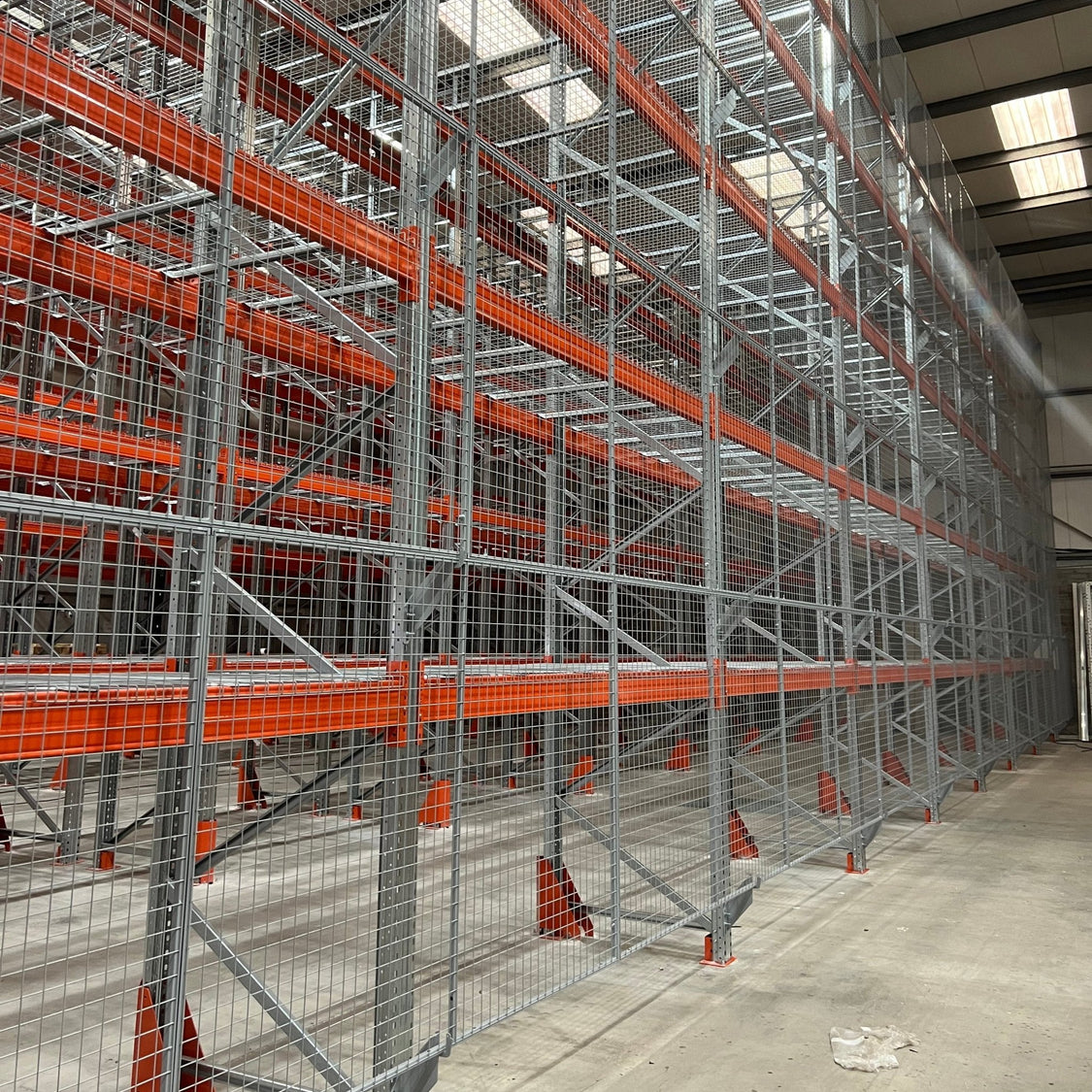
The fix: contain, don't compress. Wire mesh decking closes the gap between beams so small or awkward items can't drop through. Its open build lets sprinkler water reach the levels below. Anti-collapse mesh fixes to the back of the racking. It stops pallets or packaging falling into the next aisle. We supply the Troax Musca system for that job. Shelf bins, euro containers and pallet boxes split a deep shelf into set slots. You gain usable density without stacking a single thing higher.
5. Racking taking daily knocks
Why it happens: a lift truck striking the racking sits beside overloading as a cause of collapse.
The sign: scuffed uprights. A bent frame down at truck height that someone has decided is fine.
The fix: guard the uprights before you need to. Corner protectors and column guards soak up impact where it lands most. Crash stops and flexible barriers keep traffic off the structure. Machine guards and mezzanine guards do the same job in other parts of the building.
How often should warehouse racking be inspected?
EN 15635 is the European standard covering how steel static storage systems get used and looked after. It sets out the inspection routine a duty holder is expected to follow. Our pallet racking range carries the guards that routine assumes are already fitted. If nobody has ever done a formal walk round of your racking, start there.
6. Small parts lost in big boxes
Why it happens: awkward postures and badly set up workstations sit on the HSA's list of ergonomic hazards. Unsafe ways of getting goods down sit under storage.
The sign: pickers rummaging. Stock counts that never quite tally.
The fix: match the box to the part. Parts bins, visible storage boxes, crystal box systems and shelf bins show you what's inside. No need to open a thing. Corru-pick part bins and corru-box picking bins suit lighter lines that move fast. Tool organisers and slatwall lift hand tools onto the wall at eye level. Wall-Zone panels do the same job on a pegboard back. That frees the bench and shortens every reach. Set an industrial workbench or a modular workstation at the right height for its user. That does more for output than another shelf ever could.
7. Chemicals sitting on open shelving
Why it happens: burns, dermatitis, fire and explosion all appear under chemical agents on the HSA's stores and warehouse list.
The sign: cleaning concentrate beside consumables. Battery acid on a general purpose shelf.
Where should chemicals be stored at work?
In a cabinet built for the job, kept apart from anything they could react with. Corrosive chemical cabinets and acid or alkali cabinets hold spills in a sump. Lockable steel cabinets take care of everything else that ought to stay out of reach. This is storage that meets the rules and an inspector will read it that way.
8. People doing the work a trolley should be doing
Why it happens: the HSA names a lack of mechanical handling kit as a direct cause of manual handling injury. Back injury and strain sit beside it on the same list.
The sign: two people lifting something one pallet truck could shift.
The fix: mechanise the lift that repeats. Pallet trucks, hand trucks, platform trolleys and plastic pallets are quick to bring in. Nobody needs talking into using them. Plastic washes down easily too, which counts in a food setting.
How Irish Businesses Are Reclaiming Capacity Without Expanding
Room is a volume, not a footprint.
”Easy to forget when you're staring at a full floor. A building can be holding stock across a fraction of the cubic space it encloses. Blame racking chosen for last decade's stock.
So how do you win that volume back? Four moves cover most of it, and we'll take them in order.
Go up: use the height you're already paying for
Adding beam levels to existing racking usually beats adding floor area on speed. Two conditions apply: the uprights and the floor slab have to take it. That's a design question so it needs a drawing rather than a hunch.
Go narrower: check your aisles against today's kit
Aisle widths get set once, usually around the handling gear of the day. Then the gear changes and the aisles stay put. Worth measuring if you've upgraded trucks since the layout went in.
Go denser: match the system to the load
Longspan racking suits hand loaded goods across wide spans, with no posts in the middle to work around. Cantilever racking, tyre racking, vertical storage and racking pull-out drawers each answer a shape problem. A standard bay handles those badly. The trick is being honest about what you actually store, rather than what you meant to store.
Get things off the floor and onto the walls
Slatwall, louvre panels, wall mounted tool organisers and plastic or metal lockers all hand you back walkway. Every metre of clear floor is a metre a truck can use.
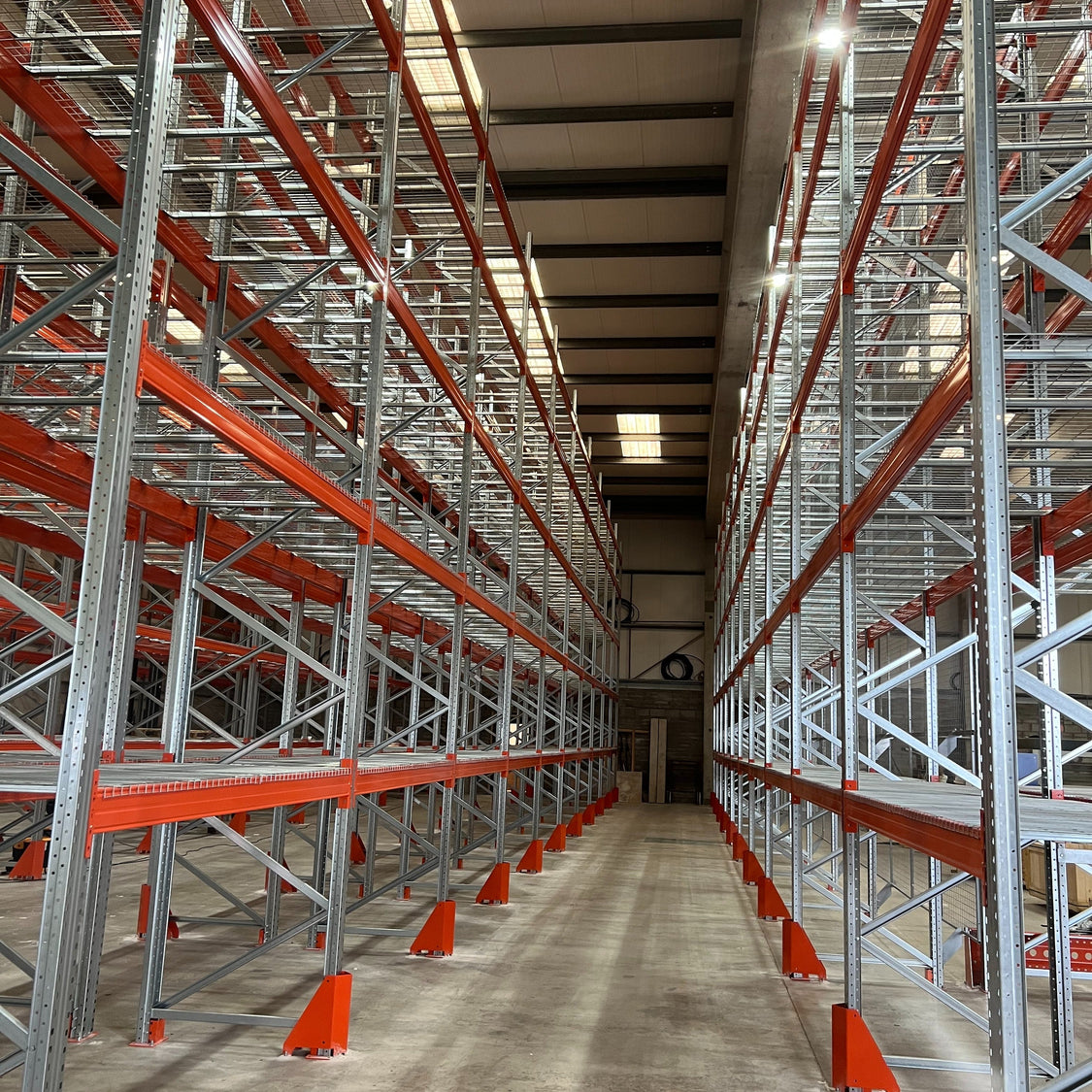
Design decides more than product choice here, though. We supply warehouse shelving for fit outs of any size, anywhere in Ireland. We run a pallet racking installation service alongside it. Most of what holds storage in Ireland back is a design question rather than a property one. A layout drawing will tell you whether the room you need already sits inside the building. Worth knowing before you sign a lease.
How Can Smart Storage Solutions Improve Workplace Efficiency in Ireland in 2026?
Speed on a storage floor comes down to two things. How far people walk. How long they hesitate. Sort those and the rest follows.
Ask anyone running storage in Ireland what slows a shift down and you'll hear the same answers.
Cut the walking
Fast movers belong near the dispatch door, at waist height. Slow movers can go high and far. Simple enough. But a layout set once will drift as the stock profile shifts underneath it. When did you last re-rank your pick faces?
Cut the guessing
Every pause costs seconds, and seconds pile up across a shift. Visible storage boxes, crystal box systems, clear labelling and load notices take the guess out of it. Tilt bins angle the contents towards you so the check happens at a glance.
Sort the posture
This one gets skipped. Modular workstations, value workbenches, sit and stand desks and adjustable industrial workbenches all move. People work at the height the job needs. Tired staff pick slowly. Matting and interlocking floor mats give a kinder surface at a packing bench. Garage floor tiles do the same in a workshop.
Safety buys you time as well
Look back at the eight problems. Every one of them costs time. A blocked aisle is a detour. An unrated shelf is a decision nobody wants to make. Anti-collapse mesh, crash stops, machine guards and property protection cages cut the pause as much as the risk.
One last note. We're 100% Irish owned and our stock sits here. That means next business day delivery on orders placed before 3pm Monday to Thursday. We deliver across the Republic of Ireland and Northern Ireland. Handy when you want to fix something the same week you spot it.
Storage fixes in Ireland start at home
A garage with boxes stacked over head height carries the same falling risk as a warehouse.
”Storage in Ireland is a home problem as much as a work one. The same index works at house scale, and the causes barely change. A shed with a bowing shelf has the same load problem, just with fewer witnesses.
Most storage fixes in Ireland at home start in one place. Get the lot off the floor and onto something rated for the weight. After that, it's a question of material.
What shelving works best in a damp garage?
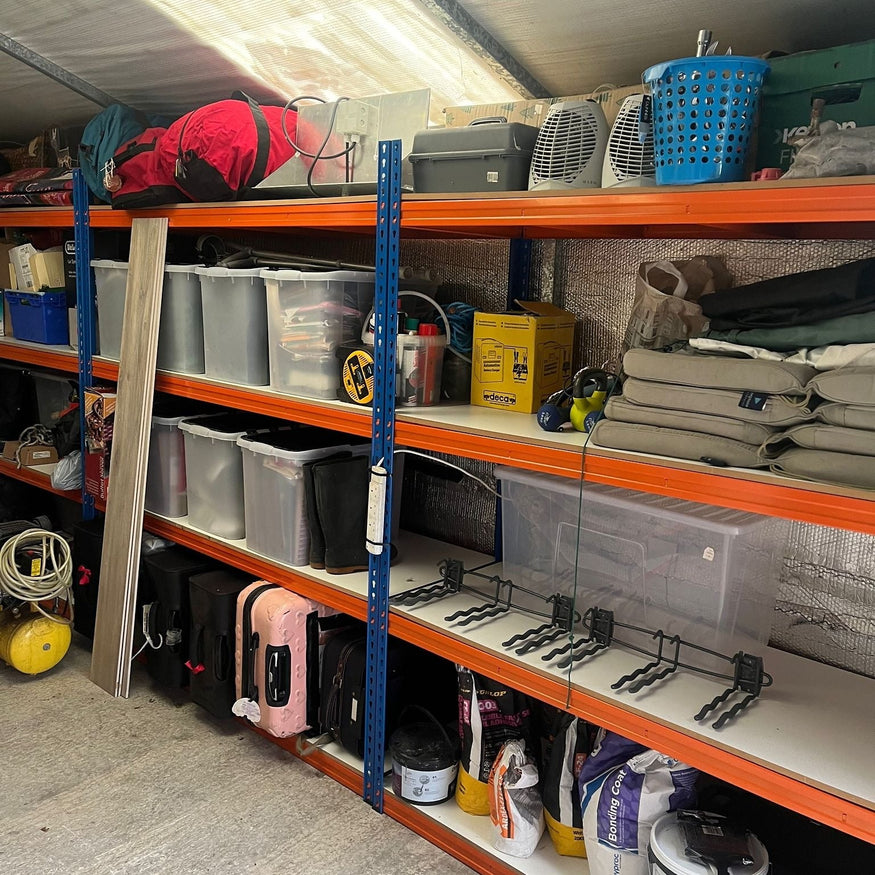
Galvanised shelving. The zinc coat resists rust. So it copes with damp air in an unheated garage or a cold store. Plastic shelving handles a damp shed and clicks together without tools. Value shelving suits light bulky items on a budget. Metal shelving and garage shelving take tools and car parts.
Then there's the room that became an office and stayed half sorted. Home and office shelving, filing cabinets, pedestals and office chairs will sort that one out.
Where chrome shelving really belongs
Chrome gets bought for the look; it does look sharp on a retail display. Its other strength is hygiene. That smooth finish wipes clean, and the open grid shelves let air move around stock. So chrome shelving suits food storage, cold rooms, chiller display and HORECA settings, as well as a shop floor.
Peter O'Mahony's shed makeover and the RTÉ Room to Improve feature both landed on the same idea.
Storage that works is storage somebody planned.
”How to audit your own space
Storage in Ireland in 2026 rewards a walk round more than a move. Take the eight entries above and walk your building. Mark the ones you can see. Be honest about it.
The pattern across the Irish storage index holds up well. The problems are ordinary and they're written down by the HSA. The fixes tend to arrive on a pallet rather than in a planning file.
What's usually missing is someone willing to make the call.
”Want a second opinion on a layout? Ring the team on 090 9673261. Or work through the warehouse shelving range and see what fits your space.


