


Buying pallet racking for the first time usually starts with an empty unit and a delivery of stock that's already booked in for the end of the month. You can see the floor and the roof, and you know roughly how many pallets are coming. What you need is a way to turn those into bays.
We'd start with the pallet rather than the building. Its size decides the beam length, and that's what decides how many pallets fit on each level. Once you know what your heaviest pallet weighs, most of the other choices fall into line behind it.
This guide takes each decision in the order you'll meet it, then works through a 200 m² unit you can check against your own.
Estimated reading time: 12 minutes
In this article:
- What is pallet racking?
- Which beam length do Euro and UK pallets need?
- How wide is pallet racking, and how much aisle do you need?
- How tall should your racking be?
- Do you need mesh decking on your levels?
- Does racking need to be anchored and protected?
- How quickly can racking arrive in Ireland?
- What drives the cost of a racking layout?
- A worked example: racking a 200 m² unit
- Choosing the right pallet racking system for your warehouse
What is pallet racking?
Pallet racking is steel storage made of upright end frames joined by pairs of beams, with each pair forming a level that holds pallets loaded by forklift. Our frames come from Kimer, the Spanish manufacturer we distribute in Ireland, and they're 1100mm deep and 3000 to 6000mm tall.
What you're actually ordering is a bay: two end frames and the beams between them. A starter bay comes with both frames. An extender bay shares a frame with the bay beside it, so a run is one starter followed by as many extenders as the wall will take.
Every bay in our pallet racking range is boltless, meaning the beams lock into the frames with no screws or special tools. You can move a level up or down later if your stock changes shape.

How much weight can each level hold?
Each level of our pallet racking holds 3000kg spread evenly on the bays in this guide, which is three Euro pallets of up to 1000kg each side by side. We also stock beam specs from 1500kg to 3500kg UDL, so you can match each level to lighter or heavier loads. UDL is short for uniformly distributed load. It’s the weight one pair of beams is rated to carry when the load is spread evenly along them, and it’s the figure that belongs on the load notice at the end of every run.
To see what each pallet can weigh, divide the level rating by the pallets on it. Three to a level means up to 1000kg each, so heavier pallets go two to a level at up to 1500kg each, which is the job our 2300mm beam does. The design rules for ratings like these sit in a European standard for adjustable pallet racking, I.S. EN 15512, published here by the NSAI. You won't need to read it but you will need the load notice, because the Health and Safety Authority says racks mustn't be overloaded and the maximum safe load has to be clearly marked on every one.
The table below shows what each part of a bay does for you as a buyer.
| Part | What it is | What it decides |
|---|---|---|
| End frame | Two uprights braced together, 1100mm deep | How tall the run is and how deep it sits |
| Beam pair | Two beams hooked between frames, forming one level | How many pallets fit on a level |
| Starter bay | Two frames plus beams | The first bay of every run |
| Extender bay | One frame plus beams, sharing the frame next to it | Every bay after the first |
| UDL | The weight one level carries, spread evenly | Whether your heaviest pallets can go three to a level |
Check every later choice against that last row. If a figure on a load sign ever puzzles you, our guide on how to read a safety load sign explains each one.
Which beam length do Euro and UK pallets need?
To fit three pallets on a level, Euro pallets need a 2700mm beam and UK pallets need a 3300mm one. A Euro pallet is 1200 x 800mm and a UK pallet is 1200 x 1000mm, and both sit on the racking with the 1200mm side running front to back.
SEMA, the UK trade body for the racking industry, works on a minimum 75mm gap between pallets and between each pallet and the upright. Three pallets on a level means four gaps. That's 2400mm of Euro pallet plus 300mm of gap, which is exactly 2700mm, and the same sum for UK pallets lands on 3300mm.
Each beam length matches up with the pallets as the table shows.
| Beam length | Pallets per level | Pallet it's sized for | Best suited to |
|---|---|---|---|
| 2300mm | 2 | Euro or UK | Pallets over 1000kg and short gaps between columns |
| 2700mm | 3 | Euro (1200 x 800mm) | Most sites running Euro pallets |
| 3300mm | 3 | UK (1200 x 1000mm) | Sites receiving UK pallets |
Pick the beam for the pallet you receive most often.
We recommend:

Best suited to: a first run of racking, with the starter at one end and extenders added along the wall in whichever beam length your pallets call for.
How wide is pallet racking, and how much aisle do you need?
Our pallet racking is 1100mm deep at every frame height, so that's the one number in your layout that won't change. A 1200mm pallet seems to want 1200mm racking, but SEMA's guidance is an 1100mm frame, so the pallet overhangs by about 50mm front and back and the forks come out cleanly. We also offer 900mm deep uprights, depending on what the customer is storing.
You'll usually be working with two shapes. A single run sits against a wall and takes about 1200mm of floor, because the pallets overhang the frame front and back. A back-to-back pair puts two runs together with 100mm between the backs of the pallets, so the frames sit about 200mm apart and the pair takes about 2500mm measured to the pallet faces.
SEMA recommends row spacers between them, so a knock on one run is shared with the other.
How much space does a forklift need between racks?
The aisle a forklift needs between racks depends on the truck. As a guideline, reach trucks often work in aisles from around 2.7 metres and counterbalance forklifts usually need 3 metres or more. The figure that counts is the working aisle on your own truck's datasheet, for the pallet size you handle.
The HSA's Code of Practice for the safe use of industrial trucks puts it plainly: traffic routes should be wide enough for the largest truck and load using them. Racking laid out for a truck you don't own is a very tidy way of storing pallets nobody can reach.
If you're in a smaller unit, our Pallet Truck 2500KG Capacity with PU Wheels 1150mm x 550mm turns in a 1276mm radius though it lifts only 195mm, so it moves pallets at floor level and won't reach a beam.

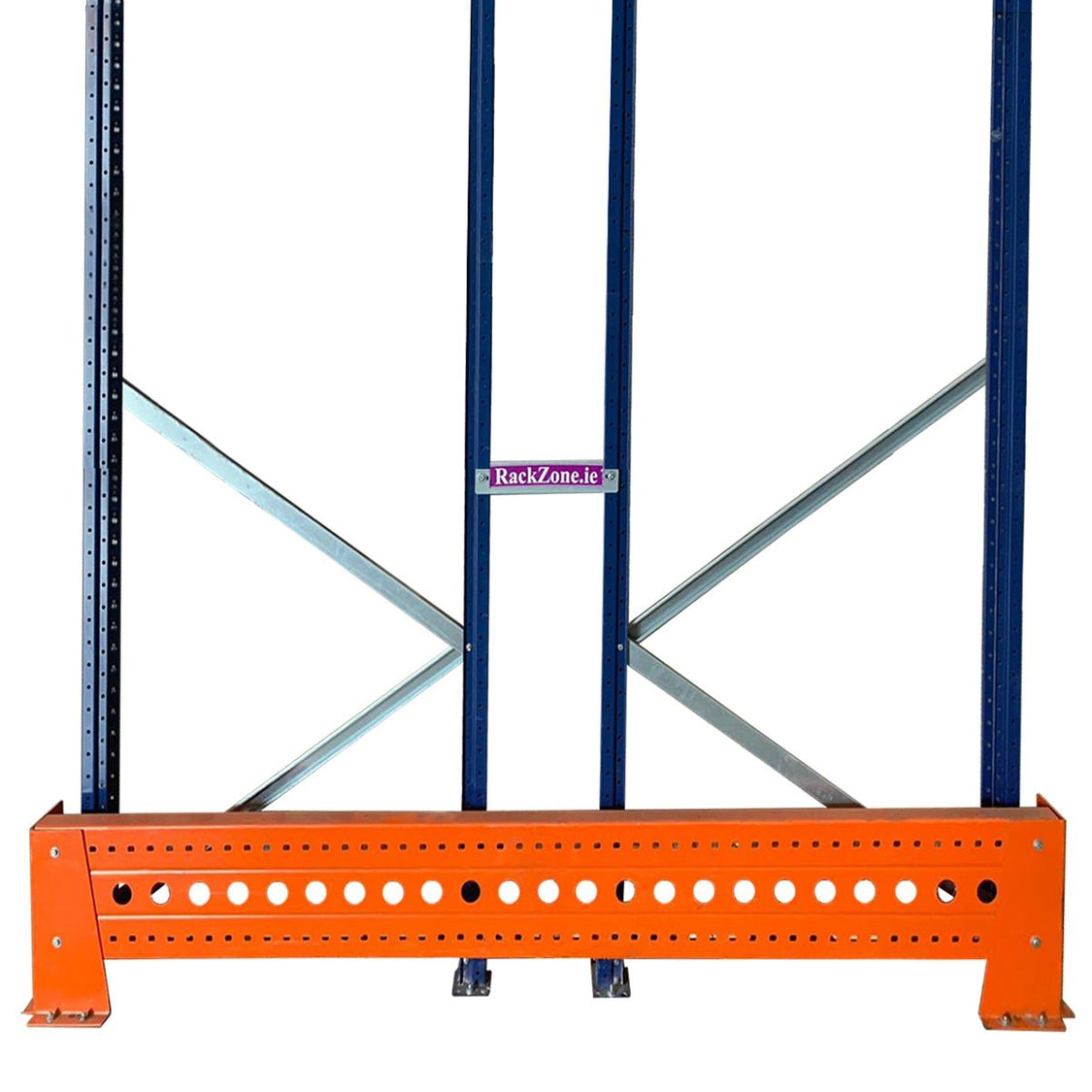
Best suited to: the open end of a back to back pair, where its 2400mm length spans both frames at the point trucks turn in.
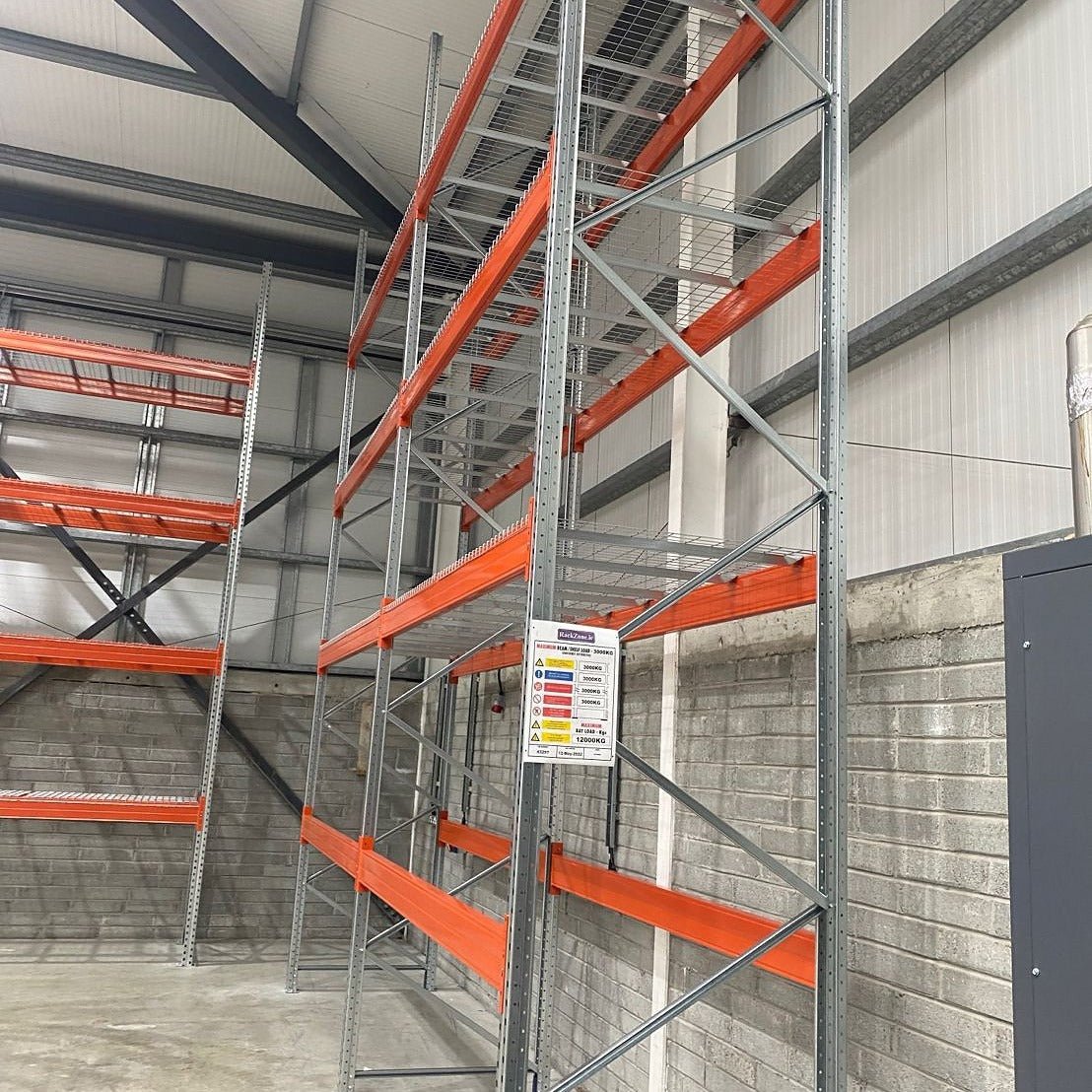
How tall should your racking be?
Your racking should be as tall as your clear height allows, measured to the lowest thing hanging from the roof rather than to the eaves. Your top pallet has to stay below whichever is lowest of the sprinkler heads, lights, heaters and roller door tracks. Sprinkler systems usually need a clear space under the heads as well, so check that figure with your sprinkler designer or insurer before you pick a frame.
Our frames come in four heights from 3000 to 6000mm and higher depending on the height available. Each one takes two or three beam levels, meaning a 6000mm frame holds no more pallets than a 3000mm one. Its extra height goes into the space between levels, which suits taller loads. If your loads are short, we'd suggest a lower frame, since it gives you the same pallet count for less steel.
Work the height out from your tallest load. Your pallet tiers are the floor plus each beam level, which makes four tiers on a three level frame. Each tier needs room for your tallest loaded pallet plus a gap above it. The forks can lift it off cleanly under the beam. The gap and the beam depth depend on your truck and the beam, and our team will space the levels to suit your loads.
The HSA's general rule is heavier items low and lighter ones higher up, so plan your bottom level around your heaviest pallets.
We recommend: our industrial pallet racking in whichever height your tallest load works out to. A 3000mm frame suits short loads under a low roof and 6000mm suits tall loads under a high one. Most business park units fall in between, on 4000mm or 5000mm.
Best suited to: buyers who've measured their clear height and their tallest loaded pallet, and want the frame that fits both.
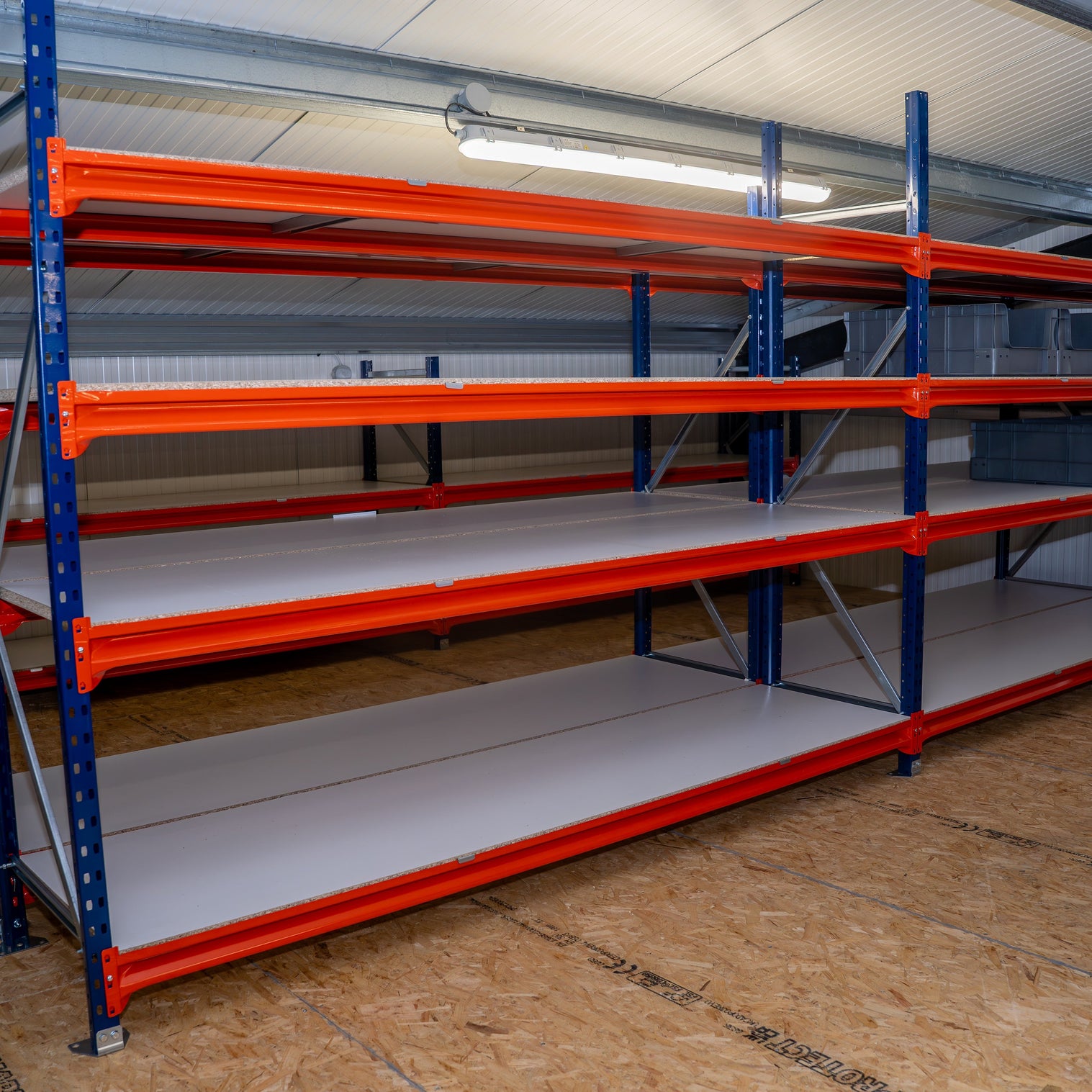
Do you need mesh decking on your levels?
You only need mesh decking where the stock isn't on a sound pallet that spans both beams. Loose cartons, drums, sacks and odd-shaped loads need something to sit on, and the decking drops between the beams to make a solid level that still lets light and water through.
Each of our decks carries 1000kg and comes 1100mm deep, in a length to match each beam. Before you load loose stock onto a decked level, ask our team to confirm what that level can take, and put that figure on its load sign.
The mesh is up to 70% open, which matters if your unit's got sprinklers, because water has to get down through the levels to reach a fire below them.
If most of your stock gets picked by hand, a bay of longspan shelving beside the racking keeps it at waist height.
We recommend:
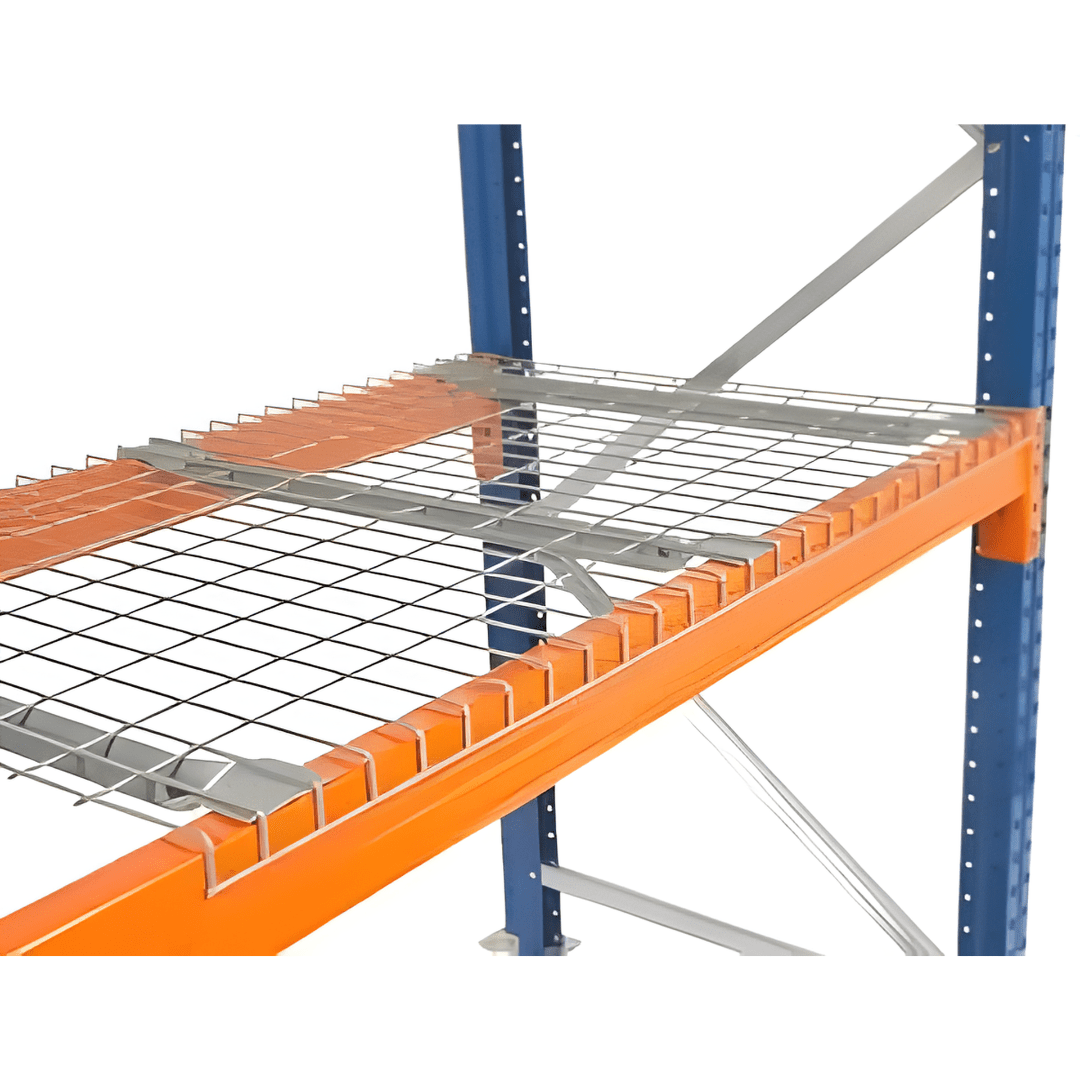

Best suited to: 2700mm bays holding loose or irregular stock, with a load sign on every run so whoever loads it knows the limit. The other lengths are in our wire mesh decking range.
Does racking need to be anchored and protected?
Racking does need to be anchored and protected. HSA guidance says racking must be put up to the manufacturer's instructions, including proper anchorage, and that uprights must be protected from impact. Bolting each frame foot to sound concrete stops a run creeping or tipping when a pallet goes down hard. Fixings have to suit your slab. Ask our team which anchors to use before the frames go up.
A truck turning into an aisle passes closest to the foot of the upright at the end of the run. Guard the aisle facing uprights and the end of each run first.
Does racking need to be inspected?
Racking needs to be inspected regularly. The HSA says it must be checked for damage, and damaged racking mustn't be used until it's been replaced or repaired.
The widely recommended practice, set out by SEMA, is a weekly visual check by a named person on site and an expert inspection at least once a year.
We recommend:
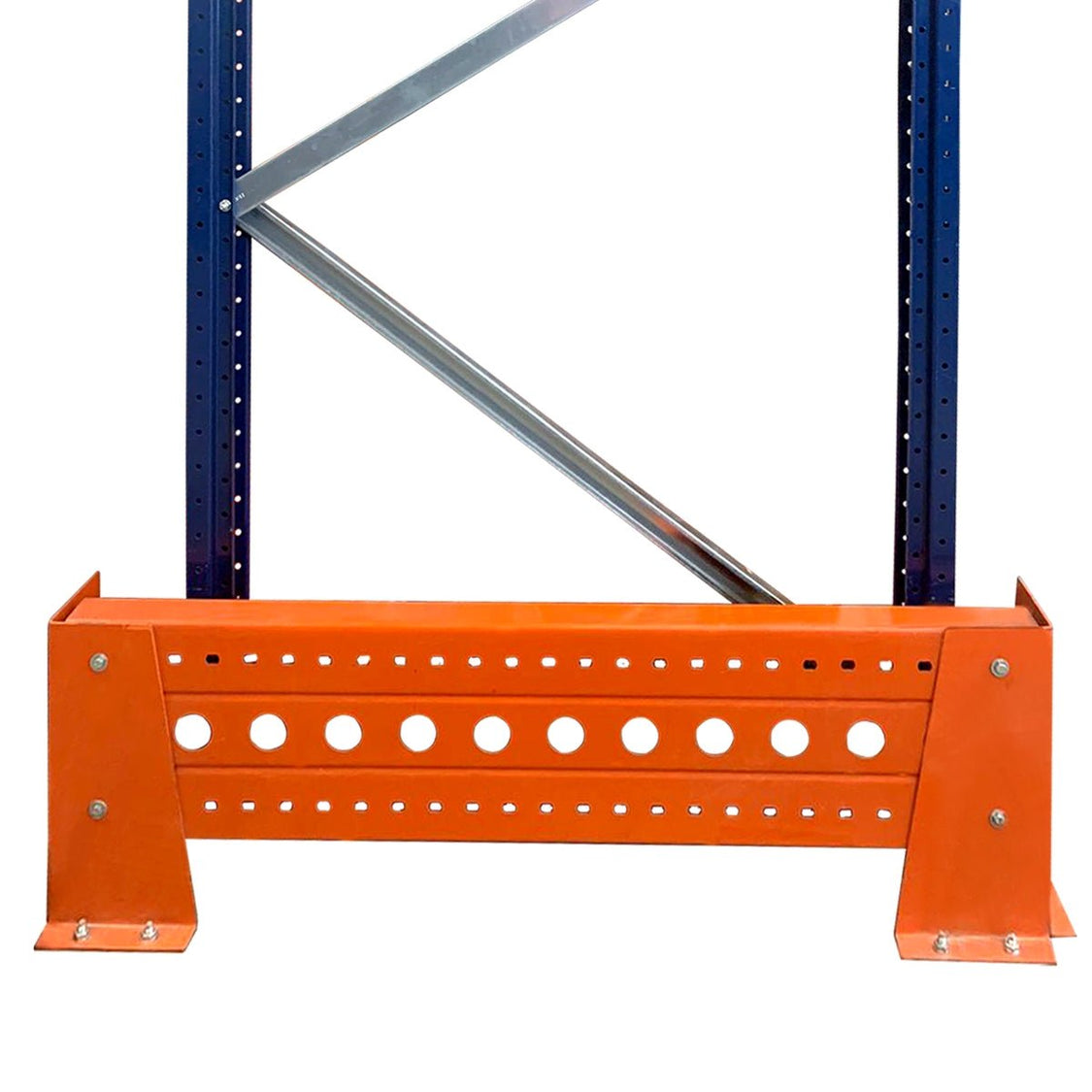


Best suited to: the end of a single wall run and the aisle facing uprights where trucks turn most often, with the 80mm or 120mm protector picked to match your upright width.
How quickly can racking arrive in Ireland?
Racking you order from us by 3PM Monday to Thursday arrives the next working day. A Friday order before 3PM arrives on Monday. We hit next day on 95% of orders, and we hold our stock here in Ireland.
Plan the unloading before you order. Every frame we sell is at least 3 metres long, and anything over about 1.8 metres may not suit a tail lift. So you'll need a forklift or other offloading kit on site, with clear access for an 18 tonne rigid. Deliveries are kerbside and the driver can't normally stay longer than 20 minutes, so have the forks ready before the lorry is.
Our delivery information page has the full terms.
The racking is boltless, meaning a competent team following the manufacturer's instructions can put it up themselves, anchors included.
We recommend: our pallet racking installation service, which covers layout and design as well as fitting, anywhere in Ireland.
Best suited to: sites without a team free to build it, or anyone who'd like the layout drawn up before a single frame arrives. Tell us the size of the area and what you're storing, and we'll quote for it.
What drives the cost of a racking layout?
The biggest driver of the cost of a racking layout is the number of pallet positions you need. Divide the cost of a layout by the positions it gives you and you've got the figure worth comparing. These are the things that move the total.
- Frame height, since taller frames use more steel for the same number of levels
- A third beam level, which adds beams but gives you half as many positions again in the same footprint
- How the run is split, since an extender has one frame where a starter has two
- Guards, upright protectors, decking, anchors and load signs
- Delivery, and whether you build it yourself or have us fit it
Our guide to how much pallet racking costs in Ireland puts numbers on each of these, including a costed 200 m² unit.
Is second hand racking worth the saving?
Second hand racking is rarely worth the saving, and SEMA advises against buying it. A used system's history is hard to trace and it may not come with a correct load notice. Replacement parts have to be approved for that system, and damage inside an upright won't show up in a photo.
We recommend: our starter and extender bays as one long run wherever the wall allows it, since every extender you add saves a frame.
Best suited to: anyone laying out more than one bay along a wall, who can compare layouts by pallet position in our pallet racking configurator before ordering.
A worked example: racking a 200 m² unit
To see how these choices add up, take a 200 m² unit 20 metres long and 10 wide, with 6 metres clear to the sprinkler heads. It's taking Euro pallets of up to 1000kg each, loaded to about 1 metre tall with the pallet included, and we've assumed a reach truck needing a 2.7 metre aisle. Check that figure against your own truck before you copy the layout.
Across the 10 metre width you can fit a wall run, an aisle, a back to back pair and a second aisle. Measured to the pallet faces that's 1.2, 2.7, 2.5 and 2.7 metres, or 9.1 metres, which leaves about 0.9 metres along the far wall. A second wall run won't fit in that strip, which leaves you three runs down the length of the unit.
Five 2700mm bays to a run comes to about 14 metres once the frames are counted. That'll leave about six metres at the door end for goods in and for the truck to turn. 15 bays in all means three starters and 12 extenders.
Four tiers of 1 metre loads, each with its lift gap and beam, should fit inside a 5000mm frame, and the top load stays under the 6 metre line, leaving room for the sprinkler clearance.
With three beam levels, each bay holds nine pallets on the beams. Across 15 bays that's 135 pallet positions, plus whatever you store on the floor under the bottom beam. No level goes over its 3000kg rating, since each pallet weighs 1000kg at most.
Before you plan your own, measure these:
- Length and width of the floor, with every column and door marked, docks included
- Clear height to the lowest sprinkler head, light, heater or door track
- Your pallet type and the weight of your heaviest pallet
- The working aisle on your truck's datasheet
- The state of the concrete where the frames will be anchored
Then put the numbers into the configurator. It takes your pallet type, bays, height and levels, shows the run in 3D and lets you email the spec over for advice. If your floor is an awkward shape, our guide to warehouse racking layouts shows five other ways to arrange it.
Choosing the right pallet racking system for your warehouse
Choosing the right pallet racking system starts with the pallet you receive most often and the weight of the heaviest one. Those two decide the beam length and the number that'll go on the load notice. Let your clear height choose the frame and your truck choose the aisle, and everything else is protection and fit out.
Our starter and extender bays line up like this for five common set-ups.
| Your set-up | Frame height | Beam length | Beam levels | Pallets per level | Beam positions per bay | Best suited to |
|---|---|---|---|---|---|---|
| Heavier pallets, short walls | 4000mm | 2300mm | 2 | 2 | 4 | Gaps between columns and pallets you'd rather not put three to a level |
| Low unit, Euro pallets | 3000mm | 2700mm | 2 | 3 | 6 | Short loads under a low roof |
| Typical unit, Euro pallets | 5000mm | 2700mm | 3 | 3 | 9 | The 200 m² example above and most business park units |
| Tall loads, Euro pallets | 6000mm | 2700mm | 3 | 3 | 9 | Tall loads with the clear height to take them |
| UK pallets | 4000mm | 3300mm | 3 | 3 | 9 | Sites receiving 1200 x 1000mm pallets |
For most first time buyers on Euro pallets, the third row is where to begin. Drop a frame height if your loads are short, and put guards at the run ends before the first pallet goes in.
We're 100% Irish owned and the sole Irish distributor of Kimer racking, with our stock held in an 80,000 sq ft warehouse in Ballinasloe. If you're not sure which set-up suits your unit, get in touch with our team or call us on +353 (0)90 9673261 and we'll talk it through.
Disclaimer: This guide gives general advice on choosing pallet racking in Ireland. The aisle widths and inspection intervals in it are guidelines, so check them against your truck’s datasheet and current HSA guidance. Product specifications were correct at the time of writing in November 2026. For advice on your own site, talk to our team before you order.


